Table of Contents
- Introduction
- Force Majeure: Concept and Definition under FIDIC Silver Book 2017
- Historical and Legal Context of Force Majeure
- Qualifying Events: What Triggers Force Majeure
- Conditions for Valid Force Majeure
- Events That Do Not Qualify as Force Majeure
- Procedural Requirements: Notices, Mitigation, Documentation
- Interaction with Local Law: Strengthening Claims
- Remedies if Force Majeure Is Denied
- Practical Claim Strategies for EPC Projects
- Case Law Illustrations: Examples and Lessons
- Flowcharts and Process Illustrations
- Best Practices for Project Managers and Contract Managers
- Conclusion
1. Introduction
In international construction projects, unforeseen events can severely affect contractual performance, timelines, and costs. Force Majeure (termed Exceptional Events under FIDIC Silver Book 2017) provides a legal and procedural mechanism to relieve parties from liability when extraordinary events prevent or delay performance.
This handbook offers a comprehensive guide to Force Majeure under FIDIC Silver Book 2017, integrating practical guidance, procedural requirements, local law considerations, and case law examples, to equip professionals with the knowledge to manage claims effectively.
2. Force Majeure: Concept and Definition under FIDIC Silver Book 2017
Clause 18 – Exceptional Events defines the scope of relief under the Silver Book.
Key Points:
- An Exceptional Event is one beyond the contractor’s control, unforeseeable, cannot be mitigated, and prevents or delays contractual obligations.
- Relief may include extension of time (EOT) and, in some cases, cost adjustment, subject to the contract.
Typical Events Recognized under FIDIC:
- Natural disasters: floods, earthquakes, cyclones
- War, armed conflict, terrorism
- Riots, civil unrest
- Government actions: export bans, sanctions, lockdowns
- Epidemics or pandemics
Illustrative Case:
In Parsons & Whittemore Overseas Co. v. Société Générale de l’Industrie du Papier (RAKTA), political unrest and conflict constituted a qualifying external event, demonstrating how international tribunals analyze force majeure in large projects.
3. Historical and Legal Context
Force Majeure stems from both civil law and common law traditions:
- Civil law (e.g., Oman, France, UAE) recognizes events rendering performance impossible, relieving liability.
- Common law requires that the event completely prevents performance.
FIDIC Silver Book integrates these by providing clauses that limit liability while allocating risk, emphasizing the contractor’s responsibility in turnkey EPC projects.
4. Qualifying Events: What Triggers Force Majeure
A Force Majeure claim is triggered when an extraordinary event occurs and directly affects contractual performance.
Trigger Criteria:
- Event is external and uncontrollable
- Event is unforeseeable
- Event prevents or delays performance
- Contractor complies with Clause 18 notice requirements
Examples in Practice:
| Event | Impact |
|---|---|
| Government bans port imports | Equipment cannot be delivered |
| Earthquake destroys site access | Construction delayed |
| Regional conflict | Shipping routes blocked |
| Pandemic outbreak | Workforce unavailable |
Case Insight:
In PBS Energo AS v Bester Generation UK Ltd (2020), the court examined whether delays were causally linked to external events. The case emphasized that proving actual impact is critical.
5. Conditions for Valid Force Majeure
For a claim to be valid, the following conditions must be satisfied:
- Beyond Control: Event outside contractor influence
- Unforeseeable: Not predictable at contract formation
- Unavoidable/Mitigated: Reasonable mitigation attempted
- Actual Impact: Performance prevented or delayed
- Causation: Direct link between event and impact
- Proper Notice: Written notification per Clause 18
- Documentation: Records supporting occurrence, duration, and effect
Case Insight:
In Parsons & Whittemore, the contractor failed to sufficiently mitigate after the outbreak of war. The arbitral panel awarded damages despite the event qualifying as force majeure.
Lesson: mitigation efforts are as important as proving the event.
6. Events That Do Not Qualify as Force Majeure
- Financial or commercial difficulties (cash flow, inflation)
- Internal supplier delays unrelated to external events
- Poor project planning or management failures
- Foreseeable events (seasonal weather, chronic political instability)
- Minor delays or cost increases
Case Insight:
Joint Venture Aveng v SANRAL showed protests did not qualify as force majeure. Contractors must carefully distinguish extraordinary external events from normal project risks.
7. Procedural Requirements: Notices, Mitigation, Documentation
To preserve entitlement under FIDIC:
- Prompt Notice: Describe the event, start date, and impact
- Mitigation: Seek alternatives (suppliers, routes, workforce)
- Documentation: Maintain government orders, correspondence, site reports
- Resume Work: Perform as soon as the event ceases
Case Insight:
PBS Energo reinforced that causation must be demonstrated in schedule impact analysis, emphasizing the need for thorough documentation.
8. Interaction with Local Law
Local civil law can strengthen claims:
- Impossibility of Performance: Release from liability
- Hardship / Changed Circumstances: Relief for excessive burden
- Government Acts: Legal justification for non-performance
- Mandatory Provisions: Overrides restrictive contract clauses if required
Example: In Oman, civil code doctrines can complement FIDIC’s Exceptional Event clauses, adding credibility to a claim.
9. Remedies if Force Majeure Is Denied
- Contractual Claim Submission
- Engineer/Employer Determination
- Dispute Board Referral (DAAB)
- Amicable Settlement / Mediation
- Arbitration (ICC or agreed forum)
- Local Law Remedies (impossibility, hardship)
Case Insight:
HydroChina HuaDong v Vinh Son showed courts can review arbitral awards, highlighting the importance of local law awareness and procedural compliance.
10. Practical Claim Strategies for EPC Projects
- Document meticulously (correspondence, schedules, site reports)
- Mitigate proactively (alternative suppliers, work sequencing)
- Provide timely notice (Clause 18 compliance)
- Quantify impacts (schedule delays, potential cost)
- Integrate local law support (impossibility, hardship doctrines)
Case Insight:
Wapcos Ltd v Salma Dam Joint Venture (2019) emphasized arbitration rights for Force Majeure claims, reinforcing the need for correct procedural steps.
11. Case Law Illustrations: Examples and Lessons
| Case | Year | Jurisdiction | Key Force Majeure Principle | Takeaway |
|---|---|---|---|---|
| Parsons & Whittemore Overseas Co. v. Société Générale de l’Industrie du Papier | 1967 | US 2nd Circuit | Political conflict qualifies but mitigation required | Mitigation efforts are critical; failure can defeat claim |
| PBS Energo AS v Bester Generation UK Ltd | 2020 | UK TCC | Causation must be clear for delay claims | Demonstrate direct link between event and performance |
| HydroChina HuaDong v Vinh Son | 2018 | Vietnam | Arbitral awards can be reviewed by local courts | Local law review can affect enforceability |
| Wapcos Ltd v Salma Dam Joint Venture | 2019 | India | Procedural arbitration rights are preserved | Always follow contract dispute resolution process |
| Joint Venture Aveng v SANRAL | 2015 | South Africa | Protests not sufficient for force majeure | Careful evaluation of qualifying events is essential |
These cases serve as practical lessons for Force Majeure claims under FIDIC Silver Book projects.
12. Flowcharts and Process Illustrations
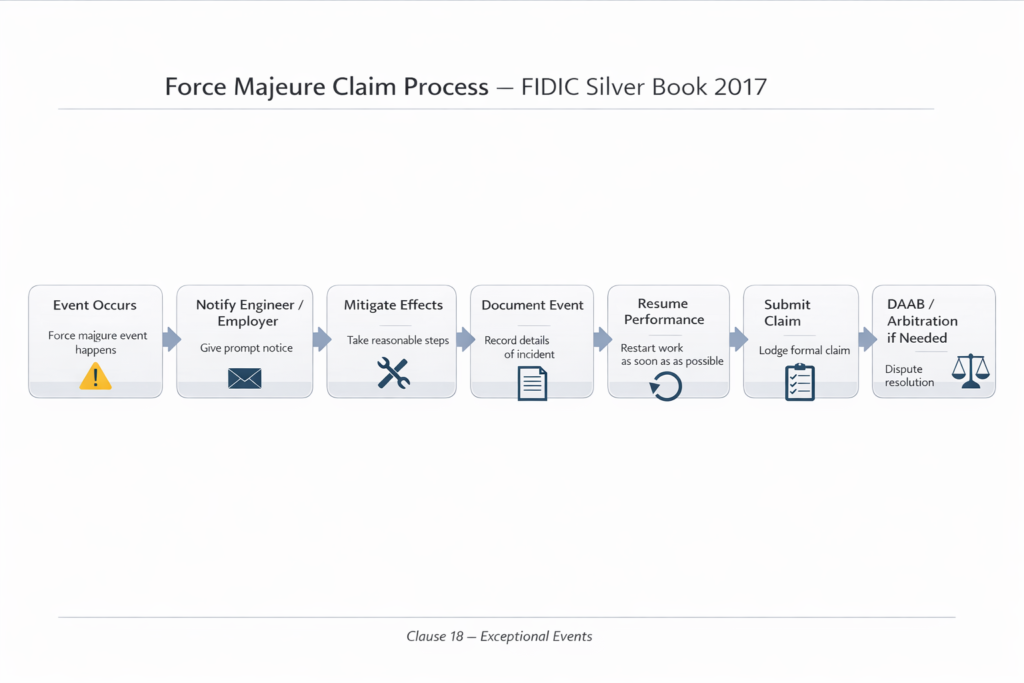
Force Majeure Claim Process (Silver Book 2017)
- Event Occurs → 2. Notify Engineer/Employer → 3. Mitigate Effects → 4. Document Event → 5. Resume Performance → 6. Submit Claim → 7. DAAB/Arbitration if Needed
13. Best Practices for Project Managers and Contract Managers
- Understand Clause 18 thoroughly
- Keep early warning logs
- Maintain continuous communication
- Train staff to recognize qualifying events
- Integrate claim management into project planning
Combining legal knowledge with proactive project management ensures effective Force Majeure claims.
14. Conclusion
Force Majeure under FIDIC Silver Book 2017 protects contractors from liability in extraordinary circumstances, but success depends on:
- Proper identification of qualifying events
- Full compliance with procedural requirements
- Meticulous documentation and mitigation
- Awareness of local law support
By following this framework and learning from case law examples, professionals can strengthen claims, reduce disputes, and enhance credibility.
(The views and opinions expressed in this article are solely those of the author and do not necessarily reflect the official policy or position of any organization or entity.)
Disclaimer: This article is for general informational purposes only and does not constitute legal, technological, or professional advice. Laws and regulations vary by jurisdiction; readers should consult a qualified professional for advice specific to their situation.
While every effort has been made to ensure the accuracy of the information provided, readers should be aware that information is inherently dynamic. Laws, regulations, technology, etc., may change over time, and the author assumes no responsibility for errors, omissions, or outcomes resulting from the use of this information.
Links to external websites are provided for convenience and do not constitute endorsement.


